Most freelance proposals are a quote with a cover page and a paragraph about how passionate the writer is. They lose to shorter documents that answer the question the client actually has, which is rarely what does it cost and almost always does this person understand what I am dealing with.
When a proposal is the right document
Send a quote when the client knows what they want and is comparing prices. Adding six pages to a decision that is already made is friction, not persuasion.
Send a proposal when:
- The client knows the outcome they want but not the route to it
- Several suppliers are being assessed on more than cost
- The work is large enough that somebody has to justify it internally
- What they asked for is not quite what they need, and you want to say so
That last case is the one where a proposal earns its keep. A quote cannot argue. A proposal can say you asked for X; here is why Y solves the underlying problem better, and it can lose you the job cleanly if you are wrong about that — which is a better outcome than winning work built on a misunderstanding.
Our guide on estimates and quotes covers the simpler document and, importantly, which of the two commits you to a fixed price.
What the client is actually reading for
Somebody receiving three proposals reads them in a particular way, and it is not front to back.
They skim for the price. Then the timeline. Then they look for evidence you understood the problem — usually by scanning the first paragraph and any headings that look specific rather than generic. Only then, if you are still in contention, do they read properly.
Two things follow.
The price and the timeline must be findable in seconds. Burying them on page six behind your company history does not delay the question; it just makes you the document they had to work at. Put them somewhere obvious and label them plainly.
Your opening paragraph is the whole proposal in miniature. If it could have been sent to any client in your industry, it has told them nothing. If it names their specific situation in a sentence that would be wrong for anyone else, they read on.
Compare:
We are a full-service agency with over ten years of experience delivering high-quality solutions for clients across a range of sectors.
with this invented example:
Your checkout loses people at the delivery-options step, which on your traffic is roughly 400 abandoned orders a month. This proposal covers finding out why and fixing it, in about three weeks.
The second one demonstrates understanding by being specific enough to be wrong.
A structure that works
Two to four pages is a useful starting point for a small project. A procurement process or a complex scope may need more detail; follow the client’s requirements.
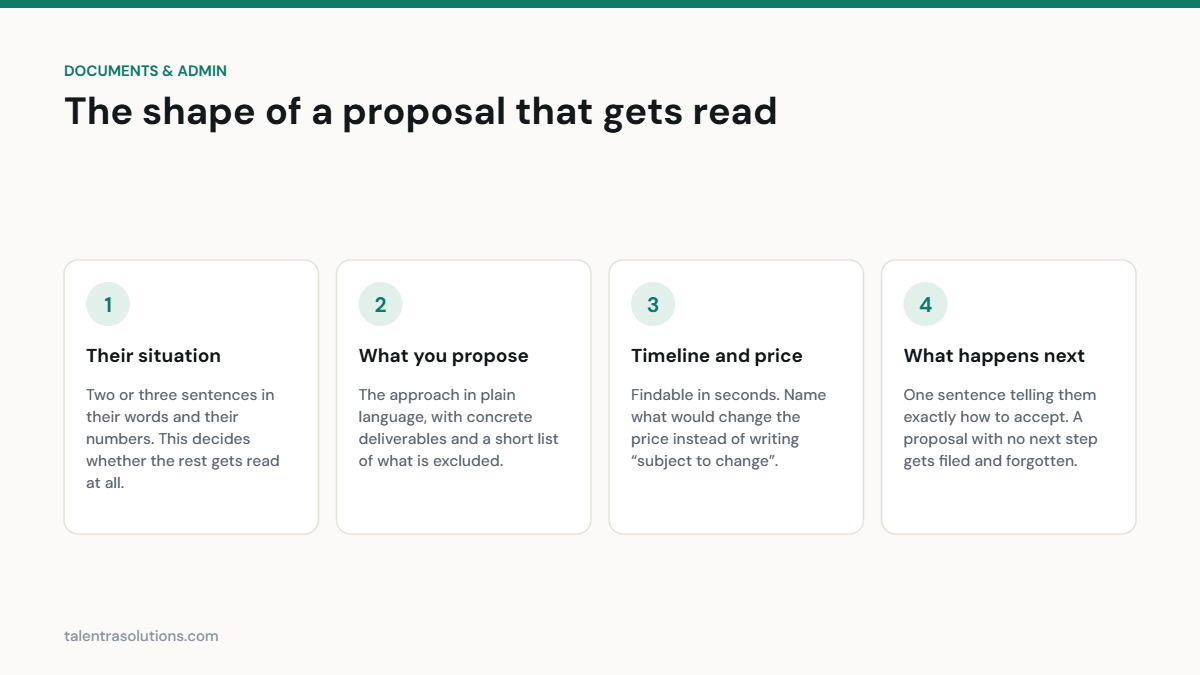
1. The situation, in their words. Two or three sentences showing you listened. Use their numbers and their terminology. This is the section that decides whether the rest gets read.
2. What you propose to do. The approach, in plain language, with enough detail that they can picture the work. Not a methodology diagram — what will actually happen.
3. What they get. Concrete deliverables. A redesigned checkout flow, implemented and tested on staging is a deliverable. Improved conversion is a hope. If you cannot point at the thing and say it exists, it is not a deliverable.
4. What is not included. The section people leave out and then regret. Three lines is enough. More arguments come from what was assumed to be included than from anything written down.
5. Timeline. Real dates or real durations, with what you need from them and when. Most freelance overruns are caused by client-side delays that nobody scheduled — name the dependencies here and they become shared.
6. Price. What it costs, what triggers a change, and the payment schedule. For anything substantial, a deposit is normal and protects both sides.
7. Why you. Short. One relevant example beats a page of logos, and relevant means the same problem, not the same industry.
8. What happens next. One sentence telling them exactly how to accept. A proposal that ends without a next step gets put in a folder.
The sections to cut
Your company history. They are hiring you for this problem, not for your founding story.
Generic methodology. Discovery, design, development, delivery describes every project ever undertaken and distinguishes you from nobody.
A wall of logos. One relevant example, described in two sentences with an outcome, is worth more than twelve marks nobody examines.
Anything about how passionate you are. Every competing proposal claims this. None of them are believed.
Pricing inside a proposal
Three practical points.
Give options, but not many. Two or three tiers shifts the conversation from should we do this to which one, which is a better conversation to be in. Beyond three, people stall.
Say what would change the price. Name the specific triggers — if the data needs cleaning before import, if more than two revision rounds are needed — rather than writing subject to change, which tells them nothing and which they will contest later.
State the payment schedule. For work of any size, a deposit before starting is normal and protects both parties. Our guide on payment terms covers which terms suit which kind of client, and why Net 15 can backfire with a large company.
Sending it
PDF. It opens everywhere, renders identically on every machine, forwards intact to the person who actually decides, and preserves the intended layout. A PDF can still be edited; it is not a tamper-proof record. Keep a dated copy of the version you sent. Use a proposal document for the offer and an invoice when a payment is due.
Keep the file small. A 30 MB proposal full of full-resolution screenshots may not survive their mail server, and will certainly annoy whoever opens it on a phone. Compress the images first — our guide on hitting a file size covers doing that without wrecking them.
Name the file properly. Proposal — Checkout redesign — Acme — Aug 2026.pdf is findable in a downloads folder three weeks later. proposal_final_v3.pdf is not.
Send it to a person, with two lines in the email body saying what it is and what the price is. Some people never open the attachment, and the email itself has to work.
Following up
Once after a week. Once more after two. Then stop.
Add something each time rather than repeating the question: a relevant example, a note about your availability, a small adjustment. Silence is usually an internal delay — a budget cycle, an absent decision-maker, a competing priority — rather than a decision about you.
A third chase changes nothing except how you are remembered.
Should proposals be free?
A short proposal is sales, and sales is a cost of doing business. Write it, do not charge for it.
A proposal that requires two days of analysis before you can even describe the approach is not sales — it is the most valuable part of the work, done free, on the chance of winning the rest. That is the point at which to propose a paid discovery phase: a small, fixed piece of work that produces the diagnosis, from which a proposal for the larger job follows naturally.
Clients who are serious usually agree. Clients who will not pay for two days of your thinking were unlikely to pay for twenty.
A one-page proposal you can adapt
Illustrative example, not a client case study. The business, scope, dates and prices below are invented to show how the sections fit together. Replace them with facts you have agreed with your client.
Proposal: a five-page website for Example Studio
Prepared by: [your name] · Prepared for: [client contact] · Version: 1 · Valid until: [date]The problem. Your current site describes the studio but gives visitors no clear way to request a project estimate. You want prospective clients to understand the services and send a useful enquiry.
The work. I will design and build Home, Services, Work, About and Contact pages in your existing WordPress installation. The contact form will collect a name, email address and project brief, and send the submission to the inbox you nominate.
Deliverables and review. You receive five responsive pages, one contact form and a 30-minute handover. The price includes two rounds of consolidated feedback. We will check the agreed pages on a phone and desktop, confirm that the form reaches your inbox, and correct faults against the agreed scope before handover.
What you provide. Final text, licensed images and access to the existing site by [date]. The schedule starts when these are available. A late input moves the delivery date by an agreed amount.
Not included. Copywriting, a shop, paid plugins, hosting fees and continuing maintenance. New pages or features need a separate written price and schedule before work starts.
Schedule. First design in week one; build and review in week two; handover after approval. Replace these durations with actual dates once the start date is agreed.
Price and payments. Example project fee: £1,200, with tax treatment stated separately where applicable. £600 before work begins and £600 at the agreed handover milestone. Each invoice states its due date. Third-party costs require your approval before purchase.
Next step. Reply with any scope changes. When the scope and terms are agreed, we will confirm the start date and issue the first invoice.
This example makes the boundary visible: adding an online shop is a scope change; correcting a contact form that does not deliver the agreed message is a fault to fix. State that distinction before discussing price.
A five-minute review before sending
- Can the client find the total price, payment milestones and delivery date without searching?
- Does each deliverable describe something you can hand over or demonstrate?
- Have you stated who supplies text, images, access and approval?
- Do exclusions, revision limits and third-party costs match your conversation?
- Have you removed invented results, unsupported claims and any other client’s confidential information?
- Is the next action clear, and is this the latest version of the document?
Frequently asked questions
What is the difference between a proposal and a quote?
A quote answers what will this cost. A proposal answers why you, and what should be done. Send a quote when the client has decided what they want and is comparing prices. Send a proposal when the approach is still open, or when several suppliers are being judged on more than cost.
How long should a freelance proposal be?
Shorter than you think. Two to four pages covers most freelance work. Length is not evidence of effort, and the sections that get skipped — company history, generic methodology, a page of logos — are usually the ones that made the document long. If a client cannot find the price and the timeline in thirty seconds, the extra pages worked against you.
Should I put the price in the proposal?
Yes. Withholding it to force a conversation is a tactic that mostly loses work: a decision-maker comparing three documents will discard the one that does not answer the question. Put the price somewhere findable, with what it includes and excludes.
Should I send a proposal as a PDF or a link?
PDF, unless the client asked otherwise. It opens everywhere, it looks the same on every machine, it can be forwarded to the person who actually decides, and preserves the layout you intended. A PDF can still be edited, so retain a dated copy of the version you sent. A link is convenient for you and one more step for them, and analytics on who opened it is not worth the friction.
How do I follow up without being irritating?
Once after a week, once more after two, then stop. Add something each time rather than repeating the question — a relevant example, a note on availability, an adjustment. Silence is usually an internal delay rather than a decision, and a short specific message is easy to reply to. A third chase changes nothing except how you are remembered.
Should proposals be free?
A short one, yes — it is sales. A long one that requires days of analysis before you can write it is consultancy, and doing it free is how freelancers end up giving away the most valuable part of the work. When the diagnosis is the deliverable, charge for a paid discovery phase and let the proposal come out of it.
About this guide
Published by Talentra Solutions. The proposal structure and follow-up suggestions are editorial guidance, not a universal rule or a claim based on a client survey. Adapt them to the project and the client’s procurement process. The worked proposal above is fictional.
For the invoice you send after agreeing the work, see GOV.UK’s invoice requirements. This reference describes invoices; it does not prescribe a proposal format.
Updated 19 October 2026: added an adaptable worked proposal and review checklist, clarified document security and separated editorial suggestions from official invoice requirements. Editorial policy · Report a correction.